Yes — lifts provided for use at work generally require periodic thorough examination by a competent person. Routine servicing does not replace that examination. The applicable requirements depend on the lift’s use and jurisdiction.
In Great Britain, the Lifting Operations and Lifting Equipment Regulations 1998 (LOLER) apply to lifting equipment used at work, including passenger lifts and combined passenger/goods lifts in workplaces. Northern Ireland has a corresponding regime under the Lifting Operations and Lifting Equipment Regulations (Northern Ireland) 1999.
This article focuses mainly on the Great Britain framework, with Northern Ireland signposted separately where relevant.
Are lift inspections mandatory under UK law?
Which lifts are covered by the requirement?
LOLER applies to lifting equipment used at work.
HSE confirms that passenger lifts and combined goods/passenger lifts in workplaces such as offices and factories are subject to periodic thorough examination under LOLER. Its passenger-lift guidance also explains that some equipment used mainly by members of the public may fall outside LOLER and PUWER, while the business operating or controlling it can still have wider health and safety responsibilities.
That means a lift should not be classified simply as “public” or “workplace” based on who happens to use it on a particular day.
The key questions are:
- whether the equipment is lifting equipment;
- whether it is provided for or used in work activities;
- who controls it; and
- which statutory framework applies.
For Northern Ireland, HSENI confirms that lifting equipment is subject to periodic thorough examination under the Northern Ireland LOLER regime. Its work-equipment and machinery guidance provides the relevant signposting.
How often must lifts be thoroughly examined?
For workplace lifting equipment, the timetable depends on how the lift is used and whether a competent person has prepared an examination scheme.
| Situation | What the requirement normally means |
|---|---|
| Lift carries people, including combined passenger/goods use | Thorough examination at least every six months, unless an applicable examination scheme specifies another interval |
| Loads-only lift | Thorough examination at least every 12 months, unless an applicable examination scheme specifies another interval |
| Exceptional circumstances affecting safety | An additional examination may be required before continued use |
| First use or installation | Specific requirements and exceptions apply; the appropriate documentation and examination arrangements need to be confirmed |
HSE’s thorough-examination guidance explains the six- and 12-month examination intervals, examination schemes and additional examinations following circumstances that could affect safety.
The written examination scheme
A competent person may prepare an examination scheme setting out when thorough examinations are required.
That scheme can specify shorter or longer intervals where the competent person judges that appropriate for the equipment, its condition, environment, use and expected deterioration.
It is not simply a device for extending statutory dates.
Where there is no applicable scheme, facilities teams should manage the normal six- or 12-month interval as appropriate.
HSE also identifies additional examination requirements in circumstances such as first use, installation or reassembly, and after exceptional events that could affect safety.
Thorough examination is not the same as maintenance
Routine maintenance and statutory thorough examination perform different functions.
Maintenance is intended to keep the lift in safe working order and may include servicing, adjustments, lubrication, testing, replacement of worn components and reactive repairs.
A thorough examination is a formal examination by a competent person to detect deterioration or defects that could affect safe continued use.
HSE explicitly states that thorough examination is in addition to normal servicing and maintenance.
In Great Britain, the Provision and Use of Work Equipment Regulations 1998 (PUWER) also apply to relevant work equipment and require it to be maintained in a safe condition and inspected where appropriate. HSE’s PUWER guidance explains how those wider duties sit alongside LOLER.
Northern Ireland has corresponding PUWER and LOLER regulations under its 1999 framework.
The practical distinction is:
maintenance keeps the equipment in suitable condition; thorough examination provides the statutory assessment required under LOLER.
Who can carry out the thorough examination?
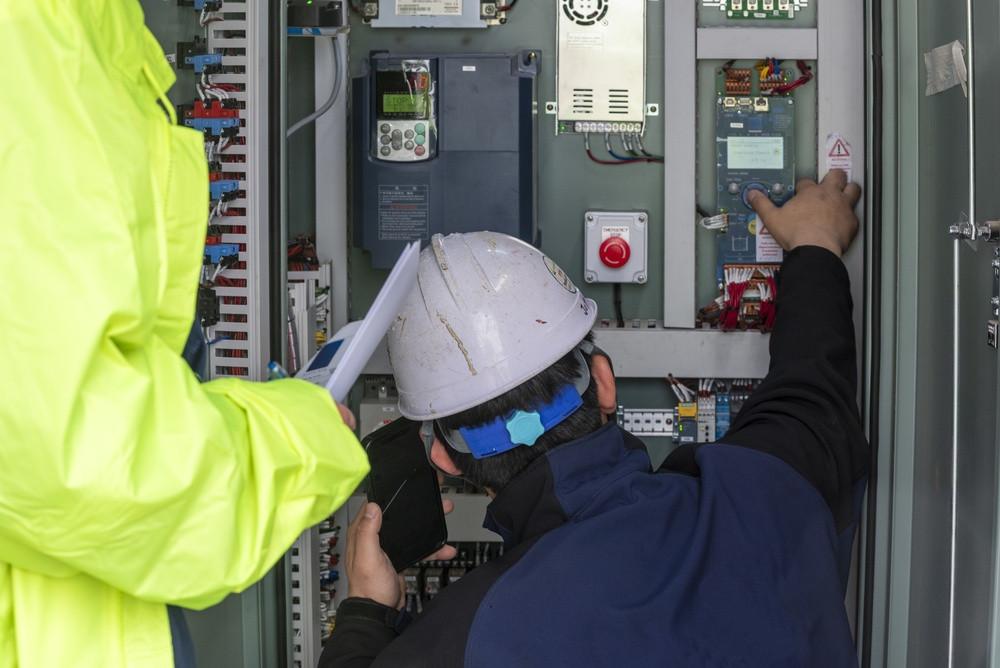
The examination must be undertaken by a competent person.
HSE describes this as someone with sufficient practical and theoretical knowledge and experience to detect defects and assess their significance.
The competent person must also be sufficiently independent and impartial to make an objective judgement.
HSE’s thorough-examination guidance explains that competence and impartiality are central to the role. HSE also advises against the same individual who performs routine maintenance carrying out the thorough examination, because they would effectively be assessing their own work.
It does not, however, state that the examiner must always work for a completely separate company.
For facilities teams, the correct test is therefore:
does the examiner have the competence and independence needed to make an impartial assessment?
Who is responsible for arranging the examination?
HSE identifies the lift owner or the person responsible for the safe operation of a lift used at work as the relevant dutyholder.
That can include a facilities manager or supervisor where they have responsibility for the lift’s safe operation.
The practical arrangement can vary.
A landlord may appoint the competent person directly.
A managing agent may coordinate examinations on the owner’s behalf.
A tenant may have responsibility where the lift is under its control.
For multi-let buildings, responsibilities should be explicit rather than assumed.
The management arrangements should establish:
- who monitors examination dates;
- who appoints the competent person;
- who receives the report;
- who reviews findings;
- who instructs remedial work; and
- who confirms that required actions have been completed.
What should the examination report contain?
The competent person must issue a written report.
Schedule 1 of LOLER sets out the required contents.
For practical management purposes, the report will typically include information such as:
- identification of the lift;
- the examination date;
- the reason for the examination;
- the competent person’s details;
- relevant safe working load information;
- defects identified;
- whether those defects are or may become dangerous;
- remedial work required;
- any stated deadline;
- the latest date by which the next thorough examination must be carried out; and
- relevant tests undertaken.
This is a summary, not a substitute for the full Schedule 1 requirements.
The report should be treated as a management document, not simply a certificate to file.

Act on findings according to their significance
LOLER distinguishes different responsibilities when defects are identified.
The competent person must notify the dutyholder promptly of defects that are or could become dangerous.
Where the defect involves an existing or imminent risk of serious personal injury, the competent person has an additional obligation to send the relevant report to the enforcing authority.
Those are separate duties.
The dutyholder then needs to act according to the report.
If the finding requires the equipment to be taken out of use, it should not continue operating until the defect has been remedied.
Where a defect does not require immediate withdrawal but the report specifies a remedial period, it must be addressed within that period, or the equipment should no longer be used once that period expires.
HSE’s L113 guidance on LOLER explains these Regulation 10 reporting and defect-management requirements in detail.
Urgent findings should not wait for routine administrative processing.
Facilities teams should preserve:
- the original statutory finding;
- its significance;
- any stated deadline;
- the required action;
- the person responsible;
- the remedial work completed; and
- the evidence used to confirm closure.
A useful management sequence is:
examination → finding → required action → owner → repair → evidence → closure
Competent-person reports can also contain additional non-statutory observations about condition. These can still provide useful maintenance information, but they should not be presented as legally equivalent to statutory defects.
How long should lift examination records be kept?
The retention period depends on the type of examination record.
For in-service periodic or exceptional-circumstance thorough examinations, retain the report until the next relevant report is made or for two years, whichever is later.
For a thorough examination before first use of lifting equipment, the report should generally be kept until the employer ceases to use the equipment.
Where the equipment’s safety depends on installation or assembly conditions, keep the relevant installation examination report until the equipment ceases to be used at that location.
A Declaration of Conformity should be retained for as long as the employer operates the equipment.
HSE’s L113 guidance on LOLER sets out these Regulation 11 distinctions and also explains that electronic records are acceptable where they are protected against unauthorised alteration and can be produced in written form when required.
These distinctions matter because the simplified two-year rule does not apply to every type of lift examination document.
Can a significant incident trigger another examination?
Yes.
A serious failure, damage or another exceptional circumstance capable of jeopardising the safety of the lifting equipment can trigger the need for an additional thorough examination.
HSE identifies examination after exceptional circumstances as part of the LOLER regime.
That means repairing the immediate fault does not automatically settle the statutory question.
Where an incident may have affected the continued safe use of the lift, competent advice should be obtained on whether an additional examination is required before continued operation.
Repeated faults and outages should also be shared with the maintenance provider and competent examiner where relevant.
A current thorough-examination report does not remove the need to assess new faults, deterioration or changes that may affect safe use.
Precision FM’s related article on L113 guidance on LOLER covers wider operational issues such as maintenance history, recurring faults, downtime, and contractor performance.
Keep examination status visible across the portfolio
For multi-site estates, a compact central record should show:
- lift identification and location;
- responsible dutyholder or management contact;
- current maintenance provider;
- examination provider or competent person;
- last thorough-examination date;
- next examination due date or scheme requirement;
- open statutory findings;
- remedial deadlines; and
- closure evidence.
A computer-aided facilities management (CAFM) system can support this by connecting asset information, examination dates, maintenance records and outstanding actions. Precision FM’s guide to FM-managed CAFM systems explains how this kind of operational information can be kept visible across an estate.

Keep statutory examination and maintenance connected
Lift compliance is not achieved by servicing alone, and it is not achieved by filing reports at the required intervals without acting on them.
Facilities teams need to manage the statutory examination process from due date through findings and remedial action to evidenced closure, while maintaining the lift appropriately between examinations.
The practical test is:
Can the responsible team identify when each lift is due for examination, what the latest report found, which actions remain open and who owns them?
Need stronger oversight of lift maintenance and compliance?
Precision FM supports commercial organisations through planned and reactive Hard FM, maintenance coordination and multi-site facilities management.
If lift examination dates, maintenance records and remedial actions are fragmented across sites or contractors, talk to Precision FM about a more coordinated approach to managing critical building assets.